

What is mahjong?: Understanding the game, its history and its cultural significance
If you’ve heard about the upcoming premiere of our all-new original movie All’s Fair in Love and Mahjong—we know what you’re likely thinking: “What is mahjong, and how can I get into it?”
Well, lucky you—we’re here to help you understand what mahjong is and give you some background and a brief history of this centuries-old game that began in China and has spread around the globe.
We’ll also tell you how the game has transformed into diverse traditions, connecting families, friends and communities. We’ll share stories from people who are devoted to the game for both deep cultural and emotional connection reasons. And we’ll cover how this game is gaining worldwide attention, showing up everywhere from clubs, teahouses and game rooms to kitchen tables and movies, like All’s Fair in Love and Mahjong and Crazy Rich Asians.
Even if you weren’t asking, “What is mahjong?” before, we bet you are now. Read on to learn more about this exciting game!
Inspired? Create and share by tagging @HallmarkStores.
What is mahjong?
So, what is mahjong? Let’s get you up on game.
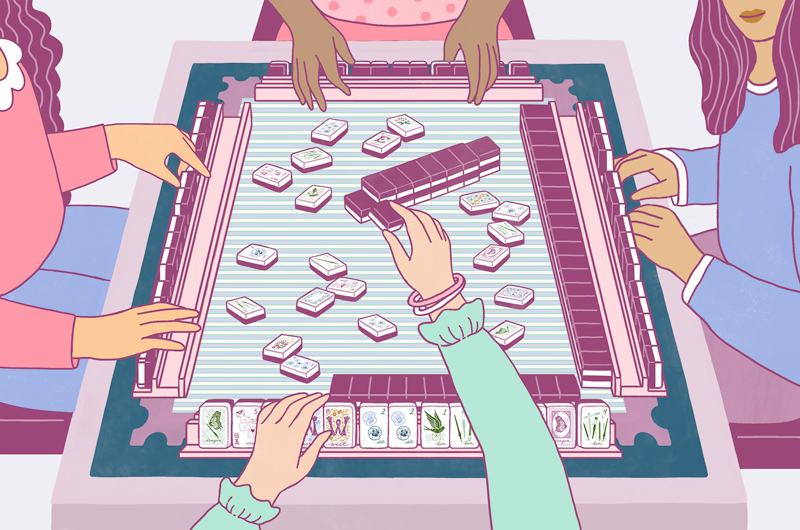
Mahjong is a tile-based (think dominoes) game of skill, strategy and luck, usually played by four people around a square table or one made specifically for mahjong. Whatever your setup, be sure to have your snacks and drinks within reach. This game gets exciting and intense!
____
“I love all tabletop games, from board games to role-playing campaigns, as I believe that the more time spent in the physical presence of people, the more enriched my life becomes.” – Jessica W. | Hong Kong, Taiwanese and Japanese Riichi styles
“It’s a bonding moment because you sit down and play mahjong not just for 30 minutes. You usually play for hours—at least in my family.” – John O. | Malaysian style
What’s usually in a mahjong set?
Each mahjong set contains, at minimum, a set of 144 tiles, which players draw from and discard in turn to form “sets” and “pairs.” The winner is the first person to form a complete 14-tile hand.
Sets also often include counters for keeping score, dice for deciding how to deal, and a marker to tell who the dealer is and what round the game is in.
____
“It’s special to me because my mother-in-law taught us. We’ve always bonded over board games. It makes me laugh thinking about how trendy it has become. When myself and my daughter learned, it was from my mother-in-law, who brought it home from her retired RV Community.” – Erin C. | American style
“My parents would play with my grandfather and my aunt, and when they were done with one game, I would help the adults shuffle for the next game. I only knew how to do that part, so shuffling was a really fun thing for me when I was young.” – John O. | Malaysian style
“I remember all the kids would gather as a willing adult taught us a simplified version of the game, and gave us quarters to play with so we wouldn’t lose our precious “red envelope” money and “gamble” our good fortunes away for the new year. It was so much fun connecting the up-and-coming, younger generation with our elders who grew up with mahjong in their childhoods. The sound of clacking of tiles after the big reunion meal is always a fond memory of mine.” – Jessica W. | Hong Kong, Taiwanese and Japanese Riichi styles
Who usually plays mahjong?
In various parts of Asia, mahjong is a co-ed social activity, played by both men and women. But, in the United States, mahjong is typically played by women in family, community, social and friendship circles.
More than a competitive game (which it is!), mahjong has deep social meaning and connecting power with cultural, social, emotional and relationship-building benefits. (It’s also good for your brain!) Both traditionally and currently, mahjong is an opportunity for people to spend meaningful time with the people who matter most to them.
____
“I grew up playing with my family, usually for Chinese holidays and special occasions. We always played games like 21, poker and mahjong.” – Heidi H. | Hong Kong style
“I learned how to play mahjong in China from my mother-in-law. She is one of those daily players and so when we visit for the holidays, the whole family plays.” – Liping Z. | Modern Chinese Diaspora style
“Mah Jongg became a way for me to connect with other moms in my neighborhood.” – Cece M. | American style
“My husband and I—as well as two of our friends—play on a square table every Monday night at 6:30 p.m.” – Jennifer K. | American style
A brief history of mahjong
What are mahjong’s Chinese origins?
More than a trend, mahjong is rooted in a long-standing cultural tradition. Morphing from earlier Chinese card games, which had existed as far back as the 1600s and 1700s, mahjong as a tile game came to life in China around the mid-to-late 1800s.
The game traveled with Chinese immigrants and merchants to the United States in the early 1900s and had already long been played in Chinese communities in cities like San Francisco and New York by the time it became popular in the U.S.
How did mahjong end up being adopted by Americans?
Mahjong became a major national craze in the United States in the early 1920s, when an American businessman named Joseph Park Babcock—who had lived in China—marketed a simplified version of the game to the West as an exotic, sophisticated and modern social activity. It caught on among tastemakers during the buzz and excitement of the fashion and lifestyle-obsessed Jazz Age.
This new version of mahjong also quickly became a fixture and culturally infused social connector in Jewish-American communities, among Jewish-American women. It became a game of empowerment, connection and mutual recognition, and led to the birth of American Mah Jongg—a new and very different version of the game.
What do the symbols on mahjong tiles mean?
Mahjong might look a little intimidating at first. But once you have the basics, you’ll see why so many people are simply mahjong obsessed.
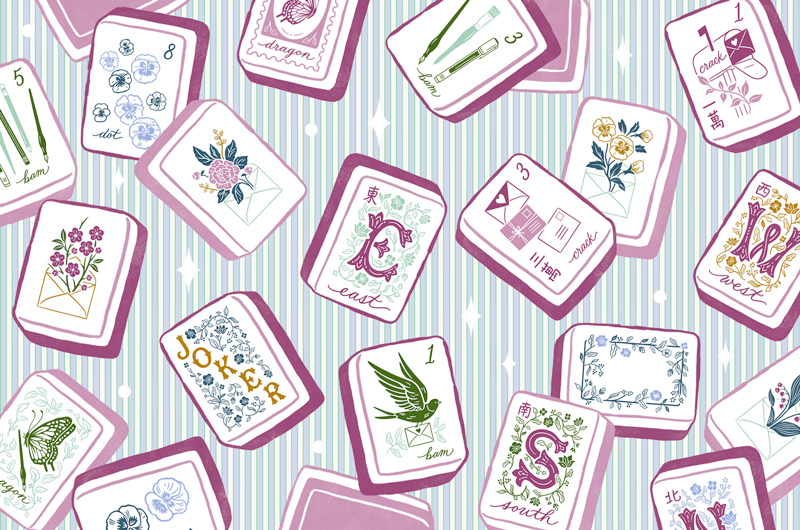
Think of it like a card game with suits. But at a mahjong table, instead of hearts, diamonds, clubs and spades, you’ll be playing with three main suits: circles, bamboo and characters, plus other tiles.
Number tiles:
Each tile is numbered one through nine. And similar to a deck of playing cards, each numbered tile appears four times.
- Dots
- Bamboo
- Characters
Honor tiles:
These tiles are not part of the suits, but they can be used to make high scores.
- Winds
- Dragons
Special tiles:
These are bonus tiles that can be used to add points, complete a hand, or replace missing tiles. Depending on the style you’re playing, some mahjong sets may include:
- Flowers and seasons
- Jokers
- Blanks
You use all the tiles together to make patterns in the game that have different values and can lead to a winning score. But it’s more than math—playing mahjong is a fun sensory experience, too! Making patterns is like making a visual piece of art, while the clacking of the tiles can be like ASMR for some players.
____
“The sound of the tiles clacking together is nothing but classic.” – Erin C. | American style
“My earliest memory of mahjong is being four or five years old and hearing the clacking of the tiles. The sound is a really big thing for me. I didn’t know the rules. I wasn’t interested in all that. But I remember building the tiles into a chimney. For somebody who, at that age, didn’t know about mahjong play, I mostly remember the sound and the feel of the smooth surface of the tiles.” – John O. | Malaysian style
“I always get excited when I make a new pattern. You have to remember all the patterns, first of all. Then, you have to get the tiles to make the pattern. And then, you have to win. So there are so many hurdles that make it so satisfying when you win.” – Heidi H. | Hong Kong style
“I remember the special pattern I achieved when I won. It was seven pairs, which is one of the hardest patterns to make. One time I also won with a “Pure Dragon” pattern, which is made from dragon tiles only.” – Liping Z. | Modern Chinese Diaspora style
Is there more than one kind of mahjong?
Today, there are over 40 different regional variations of mahjong—and these are just documented ones! As the game spread to the United States in the early 20th century, and eventually across the globe, so too did its distinct variations.
Some styles are now almost unrecognizable when compared to their Chinese origins, while others vary only slightly through tile designs or gameplay.
____
“My favorite tile is the #1 bamboo, which features a bird, usually a sparrow or peacock.” – John O. | Malaysian style
“[Choosing a favorite tile] is so hard! I would like to say my favorite tiles are the Honor tiles that are the dragons (red, green and white), but funny enough, those are some of the first tiles I discard. For some reason, I seem to notice whenever I am waiting on the 8 sou/bamboo tile (looks like two reflected “W”s), so that’s probably my favorite tile.” – Jessica W. | Hong Kong, Taiwanese and Japanese Riichi styles
Is it mahjong or Mah Jongg?
General references to the game are not capitalized, similar to other table games like poker or dominoes. When referring to the style of mahjong played in the U.S., many players use the spelling and capitalization, “Mah Jongg,” which is how it is referred to by the National Mah Jongg League. The game itself is not trademarked, which is likely why we see it spelled so many ways.
____
“The set I play with now is from China and is very heavy. The tiles are generally bigger than American versions.” – Heidi H. | Hong Kong style
“I realized our style because we were exposed to Hong Kong dramas that featured mahjong games with different terminology. Some things were similar to Malaysian style, but we have our own variation.” – John O. | Malaysian style
What are the most common styles of mahjong played today?
Within certain variations, there may also be special house rules or even distinct practices and rituals among players and families. For example, some families don’t use the flower tiles. Some use joker tiles.
This is what makes mahjong so enduring, exciting and full of possibilities. Here are some of the most common styles of Mahjong played today, including standardized and officially regulated versions:
- Hong Kong style
- Japanese Riichi style
- Taiwanese style
- Filipino style
- Singaporean style
- Malaysian style
- Modern Chinese Diaspora style
- Mahjong Competition Rules
- American Mah Jongg
- Wright-Patterson Mah Jongg
- Western Mahjong
No matter how it’s played, mahjong will continue to be celebrated as a game that brings people together.
____
“I grew up in Canton (now ‘Guangzhou’) close to Hong Kong, so we learned to play the Hong Kong version. The counting of the points is a bit different.” – Heidi H. | Hong Kong style
“I’m from the Qingdao province and grew up playing Chinese traditional style.” – Liping Z. | Modern Chinese Diaspora style
Where is mahjong commonly played today?
Whether you grew up playing or are learning about mahjong for the first time, there are so many ways the game is played today. The traditional Asian varieties—as well as their iterations—are played everywhere from kitchen tables to libraries to convention centers. Some games may simply be social rituals among friends and families, while more official tournament-style games might be played among strangers.
____
“I recently attended my first Mah Jongg tournament hosted by our teacher. It was my first time playing at tables with people I didn’t know, some people played in slightly different ways but I enjoyed learning some tips and keeping up with the rounds and learning more about scoring.” – Cece M. | American style
“I play Riichi with local club members of Ozark Riichi Club throughout Northwest Arkansas and occasionally with the Kansas City Riichi Mahjong group during board game conventions. In person, I try to play once or twice a month, depending on my schedule. However, through an app on my phone, I play a couple times a week.” – Jessica W. | Hong Kong, Taiwanese and Japanese Riichi style
How do you learn to play mahjong?
If you didn’t grow up learning by proximity or from parents and elders, it’s time to grab some friends and make new ones! After all, mahjong’s traditional four-person requirement puts socializing front and center.
It might help to consider which style of mahjong you’d like to play, how often and with who. Learning from someone who knows the game well can be highly valuable, but by far the best way to learn is to pull up your own seat to the table.
____
“A lot of Mahjong players who are serious have a set time each week and it becomes an almost religious thing. My mom’s friends had a set every single Saturday and now that my mom is in a retirement home, mahjong is a regular activity.” – John O. | Malaysian style
“We started with a group of 12 and we now have a text chat with 20 moms and that text chat gets very lively when there is an open invite to play Mah Jongg any night of the week!” – Cece M. | American style
“My mother-in-law taught my daughter and I to play about three years ago.” – Erin C. | American style
“[A special memory for me was] participating in a Mah Jongg tournament in March. [I remember] making new mahjong friends and learning old and new secrets.” – Jennifer K. | American style
____
If you’re new to mahjong and don’t know where to start or which style to play, it’s okay to ask around and do a little research. Here are some great starting places:
- Check for local mahjong clubs and communities
- Reach out to tabletop gaming communities
- Explore local cultural centers
- Ask around at your local library
- Look into retirement communities and senior centers
- Refer to books like Mahjong: House Rules from Across the Asian Diaspora by Nicole Wong for visual aids, in-depth gameplay, and variations of the game, including its cultural significance.
How has mahjong shown up in movies and other forms of modern culture?
From video games to books to movies, mahjong has been represented in a variety of styles within American media and pop culture. Modern Chinese Diaspora Style has been represented in movies like The Joy Luck Club and Crazy Rich Asians. You’ll even find brief glimpses of American Mah Jongg in films like “Driving Miss Daisy” and TV shows like Seinfeld.
Of course, these are movie and comedic depictions. Real-life mahjong is even deeper and richer in cultural meaning and connecting power. Whether it’s a major plot point, a simple shout-out, or a romantic comedy like the Hallmark original movie All’s Fair in Love and Mahjong, what’s certain is just how much mahjong has earned its place on the global stage and into the hearts of many.
____
“Whatever form mahjong takes from traditional to today, the ritual of connecting with others is the same.” – John. O | Malaysian style
“Now that I live in the United States, Mahjong is a way to stay connected to family memories and make new friends.” – Liping Z. | Modern Chinese Diaspora style
“It’s a reminder of my roots and heritage, as a Taiwanese-American and understanding how the history of the game was invented in China. It has been a common thread throughout my life as it marked different seasons with the styles I learned: simplified Taiwanese-style Dng Kong (Canto) style during my childhood, Ho [Hong Kong style] college years, and now Japanese style (Riichi) in my adult years. I love strategy tabletop games, especially one that transcends time and cultures.” – Jessica W. | Hong Kong, Taiwanese and Japanese Riichi style
____
So now you know why your friends, family, neighbors and dog groomer are mad for this culturally rich game that brings people together in skill, creativity and heart-building connection with the ones they love. After watching Hallmark’s All’s Fair in Love and Mahjong, here’s hoping you’ll be clacking with your own folks soon.
You may also like
See more-
Calendar Flip Woo-Hoo—summer’s here! June 2027 holidays and celebrations
Summer is here in all her glory and we are ready. Warm days and cool drinks lay ahead. So it’s time to flip the ca...
-

Calendar Flip Spring Forward: March 2027 Holidays and Observances
Color us excited! From the wearin’ of the green and more sunny fun to colorful Holi festivals and celebrating crayons...
-
Calendar Flip Yay for May! May 2027 holidays and celebrations
Flowers are blooming, students are graduating and moms are getting some well-deserved appreciation. What a fabulou...
-

Calendar Flip Hello, Love: February 2027 Holidays and Observances
Let’s warm up this cold month with love and connections. From valentine cards to dressing up your pet, this month has...
-
Calendar Flip Welcome a New Year: January 2027 Holidays and Observances
HAPPY NEW YEAR! If that hurt your head, you might have celebrated a little too much. When you’re feeling better, we h...
-

Calendar Flip Welcome back, spring! April 2027 holidays and celebrations
Oh, spring, we’ve missed you most of all. We don’t even care that you bring showers—we’re just excited to be outsi...
-
Mahogany There’s nothing like an HBCU homecoming
There are homecomings, and then there are HBCU homecomings. If you have ever experienced an HBCU homecoming, you unde...
-
DaySpring Room at the table
Every year, as Hispanic Heritage Month arrives, I find myself holding two things at once: celebration and grief. I ce...
-
Christmas Christmas village display ideas: Creative ways to make miniature magic
Peeking at warm glows in tiny windows, touching the intricate details on mini village structures and playing with the...
-
Christmas Stocking stuffer ideas for literally everyone on your list
The stocking stuffer struggle is real. By the time you’ve bought your main presents, you feel like you’re all out of ...
-

Keepsake Ornaments Snow much fun with these penguin pals! 🐧
Remember being a kid and trying to build a snow fort? These little penguins have accomplished your childhood dreams o...
-
Christmas All aboard the Santa Express for a happy holiday trip with the beloved Peanuts Gang!
This delightful tabletop decoration features Charlie Brown, Lucy, Linus and Sally each riding on festive, snow-covere...
-

DaySpring The epidemic of lost joy
Have you noticed that people have become unjoyful at an alarming rate? The lack of joy seems to be an epidemic in our...
-

Christmas 2026 Christmas Trends: the decorating, gifting and celebration trends shaping Christmas this year
I bought my first Christmas tree not long after I started writing for Hallmark. The rest, as they say, is holiday his...
-

Keepsake Ornaments Relive the most iconic dogfight in the galaxy 💫
Moments after escaping the Death Star space station aboard the Millennium Falcon, the band of Rebel heroes encountere...
-
Keepsake Ornaments It’s the most fabulous time of the year! 🎀✨
She's elegant, she's adventurous, she's chic...when it comes to glitzing up your Christmas tree, is there anything be...
-
Keepsake Ornaments It’s official…this is the sweetest gingerbread house ever. 🍬
We know, there are a LOT of gingerbread houses out there. But this one might just top them all. The icing so shiny it...
-
Keepsake Ornaments The final two ornaments in the collection are here! 🤩
The wait is over! The final ornaments in the Harry Potter and the Chamber of Secrets™ Collection are here! You can fi...
-
Keepsake Ornaments Busted! 🤭 The North Pole Peek Patrol is on the watch…
We all know the rules...no presents until Christmas. But a little peek won't hurt, right? Wrong! The Peek Patrol is h...
-

DaySpring When you don’t feel like it’s all good
When I start to worry, these familiar words often come to mind: “And we know that in all things God works for the goo...